
WP7 puts patients at the heart of GREG. Led by EUPATI and Novo, this work package ensures that patient voices, needs, and perspectives shape the project’s guidance, tools, and Use Cases (UCs), making Real-World Evidence (RWE) generation truly patient-centric.
RWE plays a crucial role in informing healthcare decisions, from regulatory approvals to Health Technology Assessment (HTA) evaluations. However, the voices of patients and communities are often underrepresented in these processes.
WP7 seeks to bridge this gap by:
- Establishing a diverse Patient Advisory Group (PAG) (patient experts, advocates, and community representatives) to provide ongoing feedback on GREG’s activities, from UC design to guidance and tool development, ensuring they reflect real-world patient needs. Introduced to the consortium in early 2026 and formally established in May, the PAG meets regularly with Work Package leads. Their main role is to provide direct patient input across all project activities, ensuring that patient perspectives, accessibility, and ethical considerations remain at the core of GREG.
- Delivering workshops to train GREG partners on meaningful patient involvement in RWE and Real-World Data (RWD) initiatives, ensuring all WPs integrate patient insights effectively.
- Co-creating accessible eLearning materials (hosted on EUPATI’s Open Classroom) to educate patients and the public on RWD, RWE, and their role in decision-making.
- Translating GREG’s outputs (e.g., UCs, guidance) into accessible, patient-friendly formats (lay summaries) and hosting dissemination events to share results with the wider patient community, ensuring complex findings are understandable and actionable for non-experts.
WP7 will collaborate with WP8 (Communications, Training, and Sustainability) to adapt patient-focused materials for broader audiences, including healthcare professionals, regulators, and policymakers.
WP7 ensures that GREG’s guidance and tools reflect real patient needs, not just technical or regulatory requirements. By empowering patients to understand and contribute to RWE, it builds trust in RWE and ensures innovations align with what matters most to those who use them. Through these efforts, GREG aims to create tools and recommendations that are not only scientifically robust but also patient-relevant and accessible.
WP7 is led by EUPATI and Novo, with critical contributions from the GetReal Institute, Erasmus Medical Centre, the University of Oxford, Pfizer, the Aragonese Institute of Health Sciences, Sanofi, Medtronic, and Edwards Lifesciences.
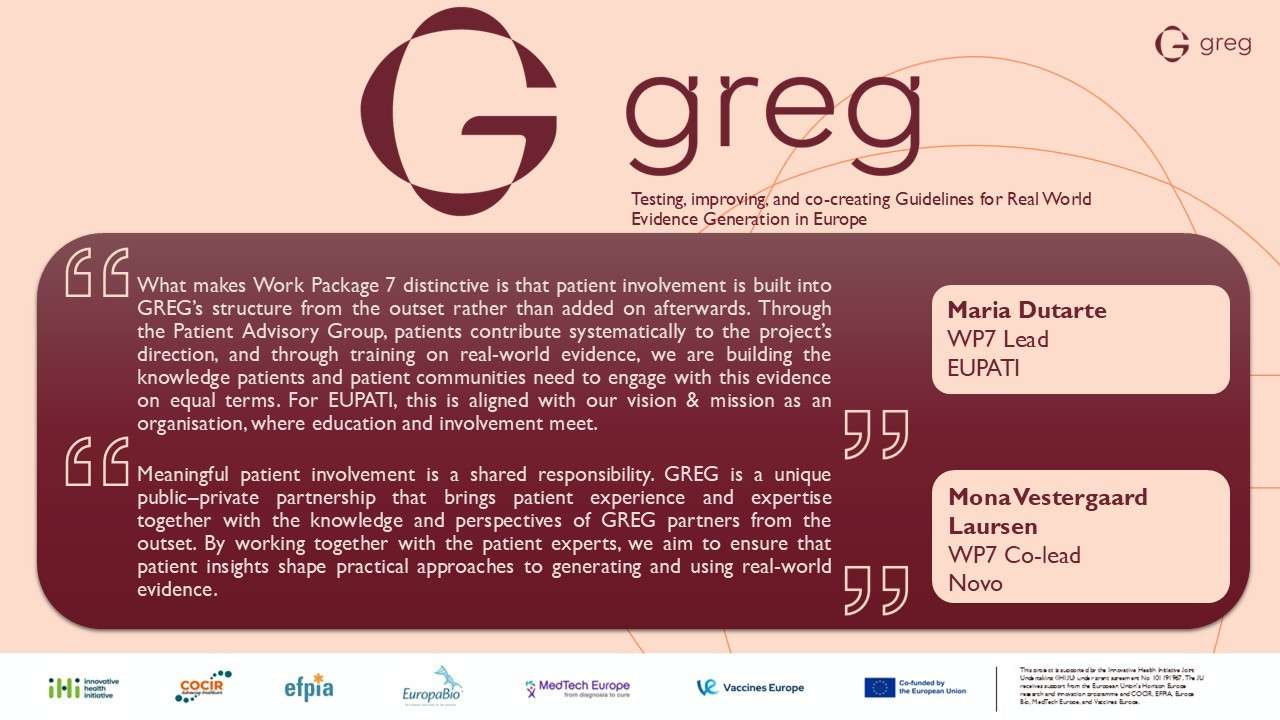
“What makes Work Package 7 distinctive is that patient involvement is built into GREG’s structure from the outset rather than added on afterwards. Through the Patient Advisory Group, patients contribute systematically to the project’s direction, and through training on real-world evidence, we are building the knowledge patients and patient communities need to engage with this evidence on equal terms. For EUPATI, this is aligned with our vision & mission as an organisation, where education and involvement meet.” – Maria Dutarte, WP7 lead from EUPATI
“Meaningful patient involvement is a shared responsibility. GREG is a unique public–private partnership that brings patient experience and expertise together with the knowledge and perspectives of GREG partners from the outset. By working together with the patient experts, we aim to ensure that patient insights shape practical approaches to generating and using real-world evidence.” – Mona Vestergaard Laursen, WP7 lead from Novo


