
Work Package 5 (WP5) tackles the challenges of medical devices and drug-device combinations. Led by the University of Oxford and Edwards Lifesciences, this WP tests existing Real-World Evidence (RWE) methods, identifies best practices, and aims to address the unique challenges and opportunities in generating reliable RWE for medical devices, ensuring that these innovations meet regulatory and Health Technology Assessment (HTA) standards across Europe.
Medical devices and drug-device combinations play a vital role in modern healthcare, offering life-saving solutions for conditions ranging from cardiovascular diseases to rare disorders. However, the evaluation and approval processes for these technologies often face hurdles due to:
- Limited availability of randomized controlled trials (RCTs), which are challenging to conduct for devices due to ethical, practical, or financial constraints.
- The need for Real-World Data (RWD) to complement traditional clinical trials, particularly for long-term safety, effectiveness, and performance in diverse patient populations.
- Variability in regulatory and HTA requirements across European countries, complicating the path to market access.
WP5 develops and tests evidence-based methods, tools, and guidance for medical devices and drug-device combinations, ensuring robust, reproducible, and actionable RWE. Collaborating with regulators, HTA bodies, industry, and patients, WP5:
- Generates prevalence/incidence estimates to support orphan device designation.
- Evaluates feasibility of WP2/WP3 use cases by analysing RWD sources and designing study protocols. Focusing on understanding what barriers and difficulties usage of RWE in acceptance in the regulatory, HTA/payment decision imply and identifying and applying alternative methodologies to increase its acceptability.
- Replicates or conducts new RWE studies (e.g., causal inference, target trial emulation, comparative effectiveness) to identify best-performing methods, benchmarking against trials.
- Pilot-tests GREG guidance (from WP1) in selected use cases, addressing rare diseases, safety signals, and long-term outcomes.
WP5 will work closely with:
- WP1 (Guidance Development) to integrate findings into the GREG Practical Guidance.
- WP2 (Regulatory) and WP3 (HTA) to harmonise methods and tools for regulatory and HTA submissions.
- WP6 (Data and Analytics) to access and analyse high-quality, interoperable RWD.
- WP7 (Patient Engagement) to incorporate patient perspectives into study design and dissemination.
- EMA, Notified Bodies, and national HTA agencies to ensure alignment with evolving guidelines.
WP5 is led by the University of Oxford and Edwards Lifesciences, with key contributions from Medtronic, Erasmus University Rotterdam, the National Institute for Health and Care Excellence, the Aragonese Institute for Health Sciences, Mölnlycke Health Care, and Johnson & Johnson.
Ultimately, WP5’s work will accelerate the development, evaluation, and adoption of safe and effective medical devices and drug-device combinations, improving patient outcomes and healthcare system efficiency across Europe.
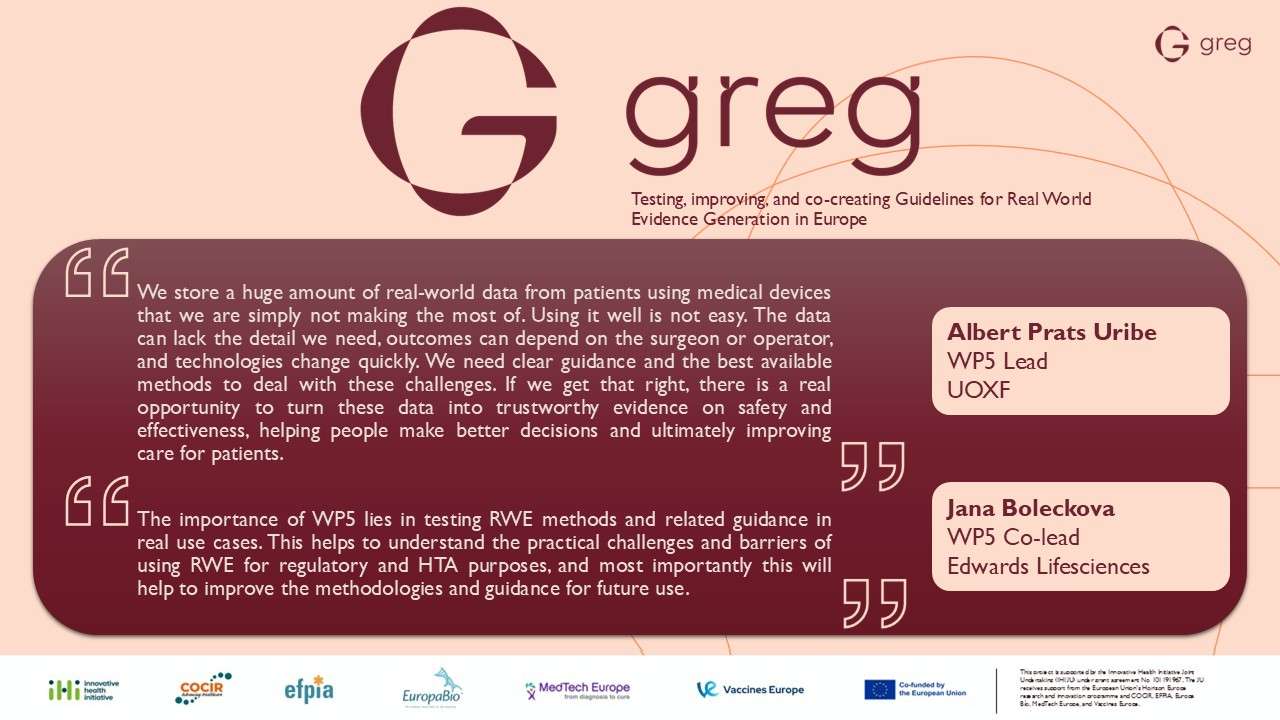
“We store a huge amount of real-world data from patients using medical devices that we are simply not making the most of. Using it well is not easy. The data can lack the detail we need, outcomes can depend on the surgeon or operator, and technologies change quickly. We need clear guidance and the best available methods to deal with these challenges. If we get that right, there is a real opportunity to turn these data into trustworthy evidence on safety and effectiveness, helping people make better decisions and ultimately improving care for patients.” – Albert Prats Uribe, WP5 lead from the University of Oxford
“The importance of WP5 lies in testing RWE methods and related guidance in real use cases. This helps to understand the practical challenges and barriers of using RWE for regulatory and HTA purposes, and most importantly this will help to improve the methodologies and guidance for future use.” – Jana Boleckova, WP5 lead from Edwards Lifesciences


