
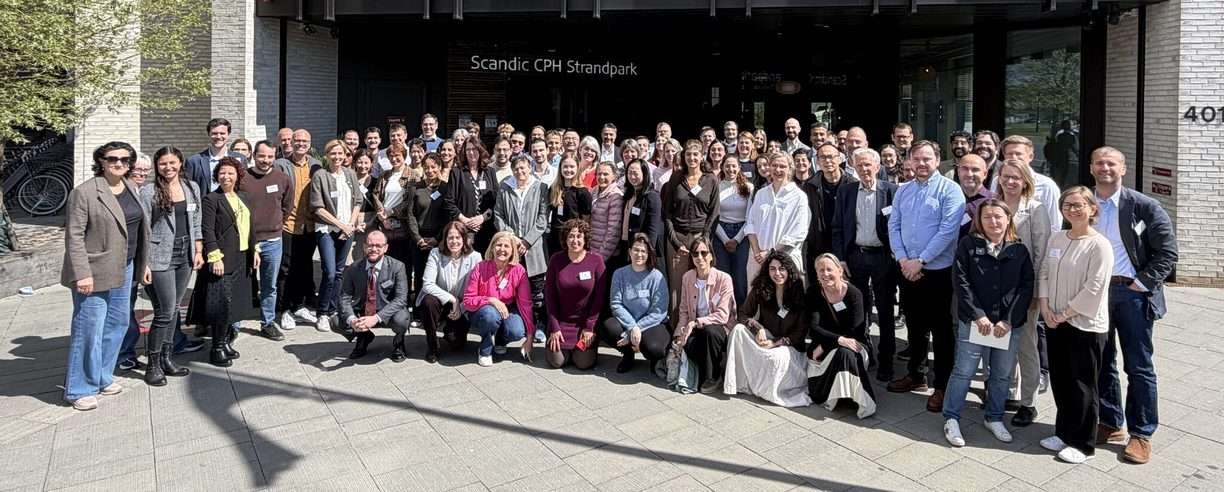
The GREG Consortium together for the first General Assembly (GA) in Copenhagen, Denmark – May 2026
Welcome back to the GREG Newsletter! Having reached the first anniversary of project launch, we’d like to give you an update on progress, achievements and upcoming events. We’d also like to give you an insight into patient involvement in the project and the work of the Patient Advisory Group (PAG). We hope you enjoy reading and look forward to sharing more information on the project’s progress and achievements in the years to come.
Across the consortium, teams have been getting to know one another, aligning on shared goals, and beginning the painstaking, necessary work of turning an ambitious vision for RWE into practical tools, frameworks and guidance that will genuinely serve patients, clinicians, scientific community and decision-makers.
Milestones worth celebrating include the early progress across multiple WP, and the growing sense – meeting by meeting, deliverable by deliverable – that GREG can become something greater than just the sum of its parts.
There have been challenges too, as there always are in large international collaborations. But the energy and commitment across the GREG consortium have been remarkable.
As we look ahead to the second year, the focus turns from building the structure to filling it with substance. The work is accelerating and, of course, the best is still to come!
Patient involvement in GREG
Real-World Evidence (RWE) is only as meaningful as the reality it reflects. That is why, within the GREG project, patient involvement is not an afterthought or a compliance checkbox – it is a founding principle, embedded in the project’s architecture from the very start.
The Patient Advisory Group: A voice that shapes GREG
At the core of GREG’s patient engagement strategy is the Patient Advisory Group (PAG), established under Work Package 7. The PAG brings together a diverse community of patients, carers, patient experts and representatives of patient organisations from across Europe, people who carry the kind of knowledge that no clinical dataset can fully capture: the lived experience of navigating disease, treatment decisions, healthcare systems and everyday life with a health condition.
This is not a consultative body that is asked for opinions at the end of a process. The PAG is involved throughout, from early co-design of project activities to the review of outputs and the development of educational materials. Its members help ensure that what GREG produces is not only scientifically rigorous but also meaningful, accessible and grounded in the realities that matter most to patients.
Why Patient Involvement in RWE matters
Real-World Data (RWD) and RWE hold enormous promise for understanding how medicines and treatments perform outside the controlled environment of clinical trials, in the varied, complex reality of daily life. But to fulfil that promise, the questions we ask of the data, the outcomes we choose to measure, and the way we communicate findings must reflect what patients actually care about.
Without patient input, there is a real risk that RWE research optimises for what is easiest to measure rather than what is most important to live with. The PAG helps to close that gap – bringing patient-relevant outcomes, priorities and plain-language communication needs directly into the design and delivery of GREG’s work.

The PAG team together at the GREG GA, May 2026.
Collaboration across the Project
The PAG does not operate in isolation. Through active collaboration with multiple Work Packages, PAG members contribute their perspectives at every stage where patient insight can add value – whether reviewing the clarity and accessibility of lay summaries, stress-testing the relevance of proposed research frameworks, or flagging blind spots that technical teams might otherwise miss.
This cross-cutting involvement ensures that patient-centredness is not siloed within a single work stream but woven through the fabric of the entire project.
Accountability and Transparency: Measuring what matters
Meaningful engagement requires more than good intentions – it requires accountability. That is why the PAG plays a direct role in developing and overseeing a set of dedicated Key Performance Indicators (KPIs) designed to monitor the quality and depth of patient involvement across GREG. These KPIs provide a transparent mechanism for tracking whether patient engagement is genuinely influencing the project, not simply happening on paper.
This commitment to structured, measurable engagement reflects GREG’s belief that patient involvement done well is one of the most important quality assurance mechanisms a research project can have.
Building a model for the future
The way GREG works with patients is also intended to demonstrate what is possible, that is, to offer a model for how patient engagement in RWE research can be done with rigour, respect and real impact. As regulators, HTA bodies and healthcare systems increasingly turn to RWE to inform decisions, the patient community must have a genuine seat at the table – not as passive subjects of data, but as active partners in how that evidence is generated, interpreted and used. And, in GREG, that seat is already taken.
Highlights from the first year
It’s been a busy year! Below are some of the highlights.
- GREG held the first meetings of its Health Technology Assessment (HTA) Expert Forum and Stakeholder Regulatory Forum, bringing together experts from across Europe and Canada.
- GREG members attended and showed off their work and the project at several international meetings, including:
- The annual meeting of the Drug Information Association (DIA) Europe 2026.
- The Observational Health Data Sciences and Informatics (OHDSI) Europe Symposium 2026.
- The Patient Engagement Open Forum (PEOF) 2026
- GREG also held the first annual Consortium Meeting in Copenhagen in May.
Read more about the first year of GREG!
Upcoming events
Keep an eye out for GREG partners presenting achievements at the following events:
- The ESC Congress 2026, 28-31 August, Munich, Germany.
- The International Society for Pharmacoepidemiology (ISPE) Annual Meeting 2026, 29 August – 2 September, Milan Italy.
- The Professional Society for Health Economics and Outcomes Research (ISPOR) Europe 2026, 8-11 November, Vienna, Austria.


